 |
| Red, White & Blue - Americans in the MTC and their companions |

Saturday, July 4, 2015
Happy 4th of July - From the Americans in the MTC

Saturday at the Chapel Next to the MTC - It's the Day we get ready for Sunday!
 |
| Big Sister Cleans the Church |
 |
| Little Brother Plays - who needs video games |
Happy 4th of July From the Robisons!

To all our American friends - enjoy a hamburger and a hotdog for us and the fireworks. Actually we found a great hamburger and a wonderful all-beef hotdog at the American Embassy celebration today in Ghana.
Africa Mourns the Passing of Yet Another Apostle - President Boyd K. Packer
A month ago, Elder L. Tom Perry passed away. Yesterday at 2 p.m., President Boyd K. Packer left this world.

This post is give a couple of insights about President's Packer's connection with Africa.
He along with Presidents Monson and Hinckley were the first three General Authorities to help organize and found the Genesis Group.
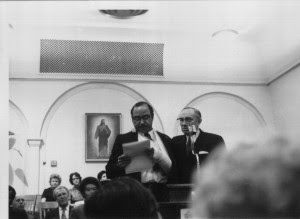

This post is give a couple of insights about President's Packer's connection with Africa.
He along with Presidents Monson and Hinckley were the first three General Authorities to help organize and found the Genesis Group.

The Genesis Group is a social organization of The Church of Jesus Christ of Latter-day Saints for African-American members and their families. It was first organized in Salt Lake City, Utah, in 1971 to provide members an organization where they could affiliate with fellow African-American members. The group was led by Ruffin Bridgeforth from 1971 through 1978. Shortly after the church's June 8, 1978, announcement of the revelation extending the priesthood to all worthy male members of the church, the group was dissolved.
The Genesis Group was reorganized in the 1990s, based on a perception that African Americans still had unique issues and could benefit from a chance to affiliate with one another, especially since many were the only members of African descent in their local wards and even in their stakes. Leaders of the group include Darius Gray (1997–2003) and Don Harwell (2003–present).Seventy President Ronald A. Rasband is currently the LDS general authority responsible for overseeing the group.
Ruffin Bridgeforth, a native of Louisiana came to Utah in 1944 for employment. In a 1996 Church News interview, he recalled that the influence of a co-worker who was a Church member helped him overcome negative opinions he had heard about the Church. Later, he met and married his first wife, Helena, whose family were Church members and who, after their marriage, accepted the gospel message from missionaries. Later as a birthday present to her, Ruffin prepared himself for baptism.
In 1971, Brother Bridgeforth had become acquainted with two other black Church members: Darius Gray, a local television news reporter, and Eugene Orr, who worked at the library on the University of Utah campus. One night they met together in a classroom at the library to discuss the formation of a support group to fellowship black Latter-day Saints.
"The most memorable thing to me," Brother Gray recalled in a recent interview, "is that in 1971, there were so few members of the Church of African descent, and to have three black Latter-day Saint men kneel, have prayer in that classroom, asking God's guidance and counsel, that's what sticks with me.
"From that point, we approached the Brethren, and after a brief period, it was decided that three members of the Twelve — Elders Gordon B. Hinckley, Thomas S. Monson and Boyd K. Packer — would meet with us and work with us."
Brother Bridgeforth, who died in 1997, recalled in the 1996 interview: "After much prayer, we came up with the name 'Genesis.' It means 'beginning.' We felt it might be the beginning for many of our people in the gospel."![]()
In October 1971, the three apostles met at the old Salt Lake Third Ward meetinghouse with about 200 black Church members, "many of them anticipating the day when the priesthood would come to them," Brother Bridgeforth said. The apostles organized the Genesis group with Brother Bridgeforth as president and Brother Gray and Brother Orr as first and second counselors.
Meanwhile, on the continent of Africa, the seeds of the gospel had been sown. In the early 1950s, devout Christians in Nigeria and Ghana had learned of the Church through literature and the Book of Mormon. They began writing letters to Church headquarters requesting more literature and Church membership.
"What began as a comparative trickle of requests in the early 1950s became a flood by the 1960s," recounted E. Dale LeBaron, former South Africa mission president, in a Nov. 3, 1998, BYU Devotional address. "More letters requesting literature were received from Nigeria and Ghana than from all the rest of the world combined."
Interested persons set up congregations and began meeting without authorization in the name of the Church.
In 1961, President David O. McKay assigned LaMar Williams, secretary to the Missionary Department, to go to Nigeria to determine if the people were sincere in their interest and willing to accept membership without holding the priesthood, Brother LeBaron said.
"He was not prepared for what he found there. He was met at the airport by 10 pastors with whom he had been corresponding. He was treated like royalty but surprised to discover that not only did each pastor operate independently, they were not even aware of each other."
Upon his return, Brother Williams provided Church leaders with the names and addresses of 15,000 unbaptized converts in west Africa. Unfortunately, Africa's most devastating civil war, the Biafran war, occurred in the area of these believers. This and other factors prevented the Church from being established in west Africa at the time.
"It is important to note," Brother LeBaron said, "that the Church made every effort to establish itself in west Africa but was prevented [by circumstances] from doing so."
Meanwhile, up until 1978, people in west Africa continued to meet unofficially as "Latter-day Saints" in various congregations. That experience is illustrated in the story of Sam Bainson, a young man who in February 1978 was invited by his sister to attend one of those congregations.
"I didn't know anything at all about the Church," recalled Brother Bainson, who today is a successful insurance agent and member of the bishopric of the Solon Ward, Kirtland Ohio Stake. The Sunday School lesson that day was on the Plan of Salvation. "This brother was talking about the purpose of life. We are here for a reason, to be tested whether we are going to be obedient to our Father in Heaven. I'd never had an experience like that before. I didn't know what I was feeling. All I knew was my mind was so clear; I felt this was true."
After the meeting, he was given a copy of the Book of Mormon. "I couldn't put it away," he said. "I'd never had anybody tell me about it before; I'd never seen it until that week. Yet I knew that book was true."
For many Latter-day Saints, it was one of those defining events, such as the Kennedy assassination or the moon landing, that fixes in memory exactly where one was and what one was doing at the time one received word of it.
In this case, the date was June 8, 1978. The news spread around the world as fast as radio and television waves could carry it: President Spencer W. Kimball had received a revelation that the day had come when all worthy male members would receive the priesthood.
The letter of announcement from the First Presidency would be sustained in general conference on Sept. 30 of that year as the one of the rare additions to the canon of scripture in this century. It is now in the Doctrine and Covenants as Official Declaration — 2.
Friday, July 3, 2015
What Can A Missionary Under Call Do To Prepare for the MTC?

Read and study Preach My Gospel, Chapter 3.
Meet James Ewudzie - Pioneer of Ghana
Every week, we are greeting warmly by a temple worker named Bishop James Ewudzie from Cape Coast. He has been working at the temple since it was dedicated and he is a true pioneer of the Church in Ghana. He drives from Cape Coast which is 3 hours away, works for a few days, and then returns back to Cape Coast to resume his bishop duties.
In this month's Liahona, he and his brother John are featured in an article entitled "James and John Ewudzie--Instruments of the Lord."
Here is a summary of the article: "In 1970, Ghana was a place where groups called themselves "The Church of Jesus Christ of Latter-day Saints" even though the Church was not officially recognized and there were no members. James and John were inspired by dreams and promptings to further the work and both were introduced to these groups by a mutual friend, Billy Johnson.
James had frequent dreams that helped him understand the teachings of Billy Johnson about the Church. At the end of a Church meeting one Sunday, Brother Johnson asked if anyone had a dream they could share with the congregation. Although he did not want to share his most recent dream, James felt prompted to do so and told the people gathered there that a certain house had caught fire in his dream. One woman from the congregation knew the house that James described and told everyone that it had burned that very day.
Missionaries arrived in 1978 soon after the revelation President Kimball received about the Priesthood. James and John were baptized, along with many others who had been waiting for the day missionaries would arrive with the authority to baptize, organize the Church, and confer the Priesthood upon worthy males. The day had been long awaited and was a joyous time.
Bishop Ewudzie continued to have strong spiritual impressions. On one occasion, he was asked to bless a baby. When he finished, he felt a humble feeling and heard, in his mind, that the Lord would bless the country of Ghana with the blessings of a temple. From that point forward, James listened carefully to the words he felt in his heart. Finally, that blessed day arrived in Ghana as well.
On another occasion, James hand been visiting with Billy Johnson about the Book of Mormon. They loved the story of Abinadi and had been discussing it. That night James dreamed that the angel Moroni appeared to him and five other men. The men followed the angel and as they came to an avenue, he stopped and pulled out the gold plates. It was a testimony to James that the Lord had sent an angel to Joseph Smith to give him gold plates to translate so the world could have the truth.
James often wondered why so many miracles were happening in Ghana at that time. Perhaps it was because of the willingness of the Ghanaians to accept dreams and visions. The Lord used these means to help the Ghanaian people to read and accept the Book of Mormon as inspired and additional scripture.
You can read the rest of the article, which features James' brother John in the July 2015 Liahona.
The article closes in sharing the historical event of December 9, 1978 when a group of 60 people were baptized in Cape Coast. Two senior couples, Elder and Sister Mabey and Elder and Sister Cannon, had been the missionaries to bring Ghana the gospel.
Just after the dedication of the Ghana temple, James was sealed to his wife but his children were not sealed to them the next day. He and his wife had two daughters and a son, who was ill with meningitis and had not spoken or walked for 9 years. James heard a voice in his mind, right after the sealing telling him to return quickly to have his children sealed. One week after the sealing of his children, his son LeGrand Richards Ewudzie passed away. James was happy he had listened to the still small voice.
In this month's Liahona, he and his brother John are featured in an article entitled "James and John Ewudzie--Instruments of the Lord."
 |
| James and John Ewudzie |
James had frequent dreams that helped him understand the teachings of Billy Johnson about the Church. At the end of a Church meeting one Sunday, Brother Johnson asked if anyone had a dream they could share with the congregation. Although he did not want to share his most recent dream, James felt prompted to do so and told the people gathered there that a certain house had caught fire in his dream. One woman from the congregation knew the house that James described and told everyone that it had burned that very day.
Missionaries arrived in 1978 soon after the revelation President Kimball received about the Priesthood. James and John were baptized, along with many others who had been waiting for the day missionaries would arrive with the authority to baptize, organize the Church, and confer the Priesthood upon worthy males. The day had been long awaited and was a joyous time.
Bishop Ewudzie continued to have strong spiritual impressions. On one occasion, he was asked to bless a baby. When he finished, he felt a humble feeling and heard, in his mind, that the Lord would bless the country of Ghana with the blessings of a temple. From that point forward, James listened carefully to the words he felt in his heart. Finally, that blessed day arrived in Ghana as well.
On another occasion, James hand been visiting with Billy Johnson about the Book of Mormon. They loved the story of Abinadi and had been discussing it. That night James dreamed that the angel Moroni appeared to him and five other men. The men followed the angel and as they came to an avenue, he stopped and pulled out the gold plates. It was a testimony to James that the Lord had sent an angel to Joseph Smith to give him gold plates to translate so the world could have the truth.
James often wondered why so many miracles were happening in Ghana at that time. Perhaps it was because of the willingness of the Ghanaians to accept dreams and visions. The Lord used these means to help the Ghanaian people to read and accept the Book of Mormon as inspired and additional scripture.
You can read the rest of the article, which features James' brother John in the July 2015 Liahona.
The article closes in sharing the historical event of December 9, 1978 when a group of 60 people were baptized in Cape Coast. Two senior couples, Elder and Sister Mabey and Elder and Sister Cannon, had been the missionaries to bring Ghana the gospel.
Just after the dedication of the Ghana temple, James was sealed to his wife but his children were not sealed to them the next day. He and his wife had two daughters and a son, who was ill with meningitis and had not spoken or walked for 9 years. James heard a voice in his mind, right after the sealing telling him to return quickly to have his children sealed. One week after the sealing of his children, his son LeGrand Richards Ewudzie passed away. James was happy he had listened to the still small voice.
Thursday, July 2, 2015
Church Updates Missionary Wardrobe Requirements for Africa (and many other areas)

In a release made July 2nd, the Church shared a new policy for some missionaries: suit coats may no longer be required. The Church statement explained, "To reduce the financial burden on missionaries and their families, elders who are called to serve in missions identified by the Church as having hot climates will no longer be required to purchase or wear suit coats. Missionaries called to serve in these missions will be notified in their call packets."
Areas that this applies to includes those in Africa, Asia, Central America, the Pacific, and South America.


You can download the full list of specific missions this applies to at Mormon Newsroom.
Two years ago, the Church updated the wardrobe for male missionaries, allowing them more options for their dress. That change also loosened the dress code for missionaries in warmer climates, allowing them to wear closed-toed, closed-heeled sandals on regular days.
Although these official changes are new, missions have long adapted for climate and culture. For instance, some missionaries in warmer climates have for years worn short sleeve white shirts and dress pants on regular days, reserving suits for Sundays and special occasions. Male missionaries serving in Samoa will sometimes wear the traditional dress lava lava.
Most importantly, though, the guidelines still encourage missionaries to remember Who they represent and to present themselves accordingly. "Servants of the Lord have always counseled us to dress appropriately to show respect for our Heavenly Father and for ourselves," said President Thomas S. Monson in April 2010 general conference. "The way you dress sends messages about yourself to others and often influences the way you and others act." (http://www.ldsliving.com/missionary-wardrobe-changes/s/79355)
Subscribe to:
Posts (Atom)